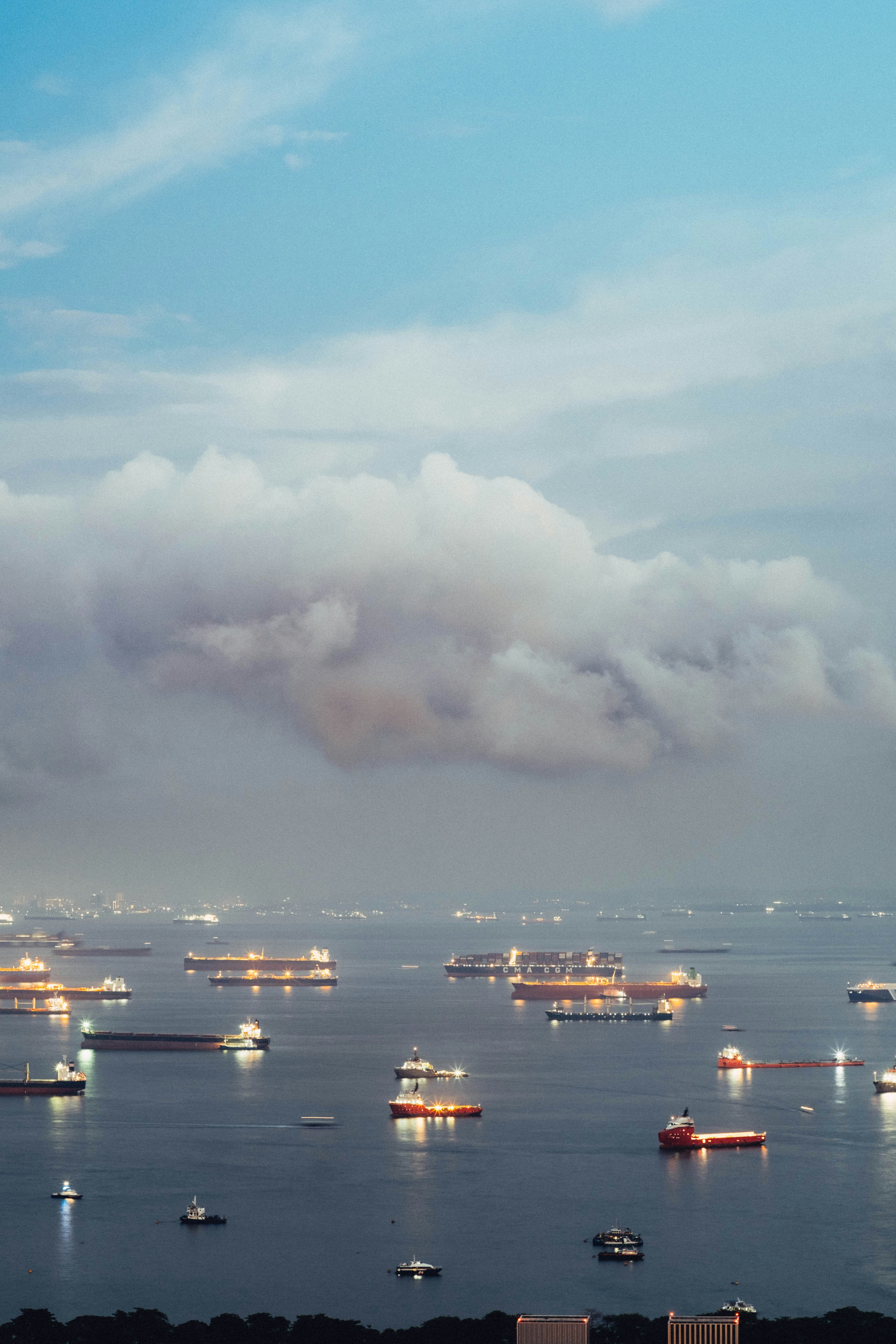
- Hormuz is no longer just an oil story: it is a choke point for energy, fertiliser inputs, industrial chemicals and capital recycling.
- The first inflation risk is agricultural: gas-linked ammonia and urea connect Gulf stress directly to crop yields and food prices.
- The technology stack is exposed too: sulfur, methanol and gas-linked inputs sit beneath metals, electronics and semiconductor fabrication.
- The monetary angle is slower but deeper: as trade fragments and settlement becomes strategic, gold is re-emerging as neutral collateral.
A system, not a shipping lane
The Strait of Hormuz is still described as the world's most important oil chokepoint, carrying close to a fifth of global petroleum liquids and a similar share of liquefied natural gas. That description is accurate, but no longer sufficient.
What moves through this corridor is not just energy. It is the upstream architecture of the global economy: the natural gas that feeds fertiliser, the sulfur that underpins both agriculture and metals, the methanol that sits inside plastics and industrial materials, and the revenues that increasingly fund large parts of the global technology cycle.
Treating Hormuz as an oil story misses the point. It is a point of convergence where systems that appear separate, including food, industry, capital and money, are in fact tightly coupled.
Hormuz matters not because one commodity passes through it, but because multiple critical systems converge inside the same narrow corridor.
The nitrogen constraint: where food inflation begins
The first signs of stress do not emerge where markets are most liquid. They emerge where systems are least flexible. In this case, that is agriculture.
Nitrogen fertilisers, particularly urea and ammonia, are chemically tied to natural gas through the Haber-Bosch process, linking energy directly to food supply. Roughly half of internationally traded urea and a significant share of ammonia exports are tied to Gulf-linked flows. Sulfur, essential for fertiliser processing, is also heavily concentrated in the region.
Agriculture operates on fixed biological cycles. If fertiliser is not applied during planting, yields decline permanently for that season. This creates a lagged but persistent inflation dynamic, one that is structurally different from a short-lived spike in fuel prices.
The industrial substrate: the chemistry beneath semiconductors
Beneath agriculture sits a less visible dependency: industrial chemistry. Semiconductor production depends on upstream inputs sourced through the same system.
| Input | Dependency | System Impact |
|---|---|---|
| Helium | Gas-linked production concentrated in Qatar | Semiconductor cooling and fabrication stability |
| Sulfur | Refining byproduct tied to hydrocarbon systems | Acid production, metals processing and wafer chemistry |
| Methanol | Large Gulf export share of global market | Plastics, resins and electronics materials |
These are not marginal dependencies. Sulfur prices have risen sharply in stressed markets. Methanol disruptions can threaten a meaningful share of global production capacity. When these base chemicals tighten, industrial production does not stop immediately, but it loses slack.
System linkage: from gas to AI
The global technology system is not detached from physical inputs. It is built on them. Data centres, compute clusters and AI infrastructure look digital at the surface, but their foundation remains chemical, material and energy-intensive.
The monetary shift: the slow fracture of the dollar
For decades, the global energy system anchored structural demand for the US dollar. Oil priced in dollars created reserve demand, and those reserves were then recycled into US financial markets.
That system is not collapsing. It is diluting.
As trade becomes more politicised, settlement becomes strategic. Bilateral arrangements increase. Non-dollar transactions expand incrementally. Over time, this produces a more fragmented system, one that increasingly needs a neutral anchor.
Gold is filling that role. Not necessarily as currency, but as collateral.
Reserve Fragmentation in Three Numbers
Official reserve data still shows a dollar-dominant system, but the direction of travel is gradual dilution rather than collapse. At the same time, central-bank gold demand and the annual gold price have both reset materially higher.
US dollar share of allocated FX reserves
World Gold Council reported net central-bank buying of 588.4 tonnes in 2015, 1,044.6 tonnes in 2024, and 863.3 tonnes in 2025.
World Gold Council reported an annual average LBMA PM gold price of $2,386 per ounce in 2024 and $3,431 per ounce in 2025.
Structural Shift in Reserve Behaviour
Read together, the reserve data and gold data point to the same conclusion: the dollar remains dominant, but the system is carrying more diversification behaviour and more demand for neutral reserve assets than it did a decade ago.
Allocated FX reserves: lower dollar concentration
Gold: stronger official demand and a higher price base
Inflation in a fragmented system
In a dollar-centric system, shocks are partly absorbed through deep liquidity and stable capital channels. In a fragmented system, those buffers weaken. Currency volatility increases. Hedging costs rise. Supply shocks transmit more directly.
Inflation becomes harder to contain and more likely to persist.
Capital flows and the AI dependency
Hydrocarbon revenues flowing through Hormuz are recycled into sovereign wealth pools that increasingly fund long-duration technology infrastructure. Gulf capital now matters not only for energy markets, but for the financing of data centres, chips and the broader AI build-out.
This creates a feedback loop between resource stability and technological expansion. The AI cycle is not purely digital. It is partly energy-financed.
Africa: exposure and adaptation
African economies face amplified exposure because fertiliser dependence, higher food weightings in CPI and currency sensitivity make external shocks travel quickly into domestic inflation.
But fragmentation also creates an incentive to regionalise. Intra-African trade, local fertiliser production and shorter supply chains can become practical buffers against system-wide imported shocks.
The real constraint
The global economy has been optimised for efficiency, not resilience. Critical inputs are concentrated. Supply chains are stretched. Financial systems assume stability until stress reveals how tightly the layers are linked.
When disruption comes, food, technology, capital and money begin to move together.
The Strait of Hormuz is only 21 miles wide. But it connects enough of the global system that its disruption is no longer regional.
It is structural.
The Ledger View
- The chokepoint lens is too narrow: Hormuz is best understood as a systems junction, not simply an oil passage.
- Food inflation may show up first: fertiliser dependence makes agriculture one of the least flexible parts of the chain.
- Technology is not insulated: the semiconductor and AI stack still depends on volatile upstream chemistry and energy inputs.
- Monetary fragmentation is the slower consequence: as reserve systems become less singular, gold gains importance as neutral collateral.