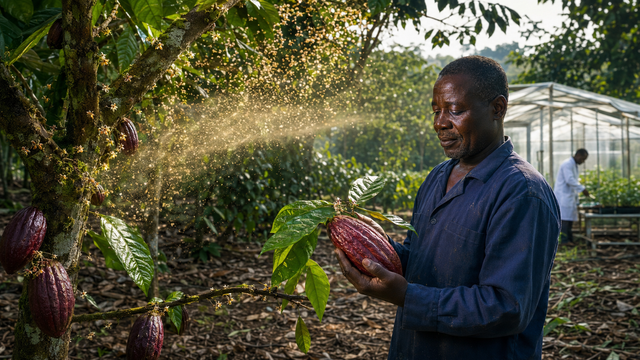
The next battle over chocolate may begin not in a factory or on a commodity exchange, but at the boundary between two farms.
On one side stands a cacao tree altered with CRISPR to survive disease, heat or drought. On the other stands a conventional tree owned by a smallholder who never bought the technology, never signed a licence and may never know that pollen has crossed into the next generation of seed. The biological event is ordinary. The legal and economic consequences are not.
This is not yet a report of gene-edited cacao spreading through West Africa. Mars describes its work with universities as preliminary plant research, and its 2025 agreement with Pairwise gives the company access to CRISPR tools, including the SHARC enzyme, for cacao research and development. Publicly available material does not establish commercial planting in Côte d'Ivoire or Ghana. That distinction matters. The controversy is prospective, which means policymakers still have time to decide how the gains, costs and liabilities should be allocated before the first large-scale release. [1],[2],[3]
Chocolate's supply crisis is real
The case for innovation is not difficult to understand. Cocoa production is exposed to ageing trees, volatile rainfall, rising temperatures and destructive diseases such as cacao swollen shoot virus and black pod. The 2023/24 season ended with a global supply deficit of roughly 489,000 tonnes; supply recovered in 2024/25, but the shock revealed how little spare capacity exists in a crop concentrated in a small number of producing countries. Gene editing promises to compress breeding timelines and produce varieties that are more resilient, productive or resource-efficient. [4]
Mars is also hedging in another direction. In Germany it has begun testing a BALISTO trail mix containing ChoViva, a cocoa-free confectionery ingredient made from sunflower seeds. The combination is economically revealing: improve the biological asset while simultaneously developing a substitute for it. For a multinational buyer, this is rational portfolio management. For a cocoa-growing country, it is a warning that the buyer has more exit options than the farmer. [15]
That imbalance should shape the debate. Côte d'Ivoire still depends on cocoa for rural incomes, foreign exchange and public revenue. The World Bank has estimated that the country supplies about 40% of global cocoa while receiving only 5% to 7% of the profit generated across the value chain. More than half of Ivorian cocoa producers and their families were estimated to live below the national poverty line. A technology that stabilises supply can therefore be valuable, but its distributional design matters as much as its agronomy. [14]
Pollen does not recognise a title deed
Cacao's reproductive biology makes coexistence a serious governance problem. The tree is frequently outcrossing and relies on insects, especially tiny midges, to move its heavy pollen. Most movement is local: one genetic study found that most within-plot dispersal occurred over distances of up to 28 metres. Yet research in Bolivia recorded pollen movement of up to three kilometres and gene flow between cultivated and wild populations. These figures should not be converted into the claim that every edited tree will inevitably contaminate an entire region. They do, however, make zero gene flow an unsafe regulatory assumption. [5],[6]
The risk is amplified by farm structure. Cocoa is grown across dense mosaics of small plots, and farmers often reproduce trees through locally available planting material. Informal seed systems are not a marginal feature of African agriculture; across several African countries, FAO-cited research found that smallholders obtained about 90% of seed through informal channels. In a perennial fruit crop, the consequences of one reproductive decision can persist for decades. [16]
This is the first economic fault line. The developer chooses the technology and may earn the return. Neighbouring farmers do not choose the exposure, yet may bear the costs of testing, buffer zones, segregation, rejected lots, legal advice and lost access to non-GM or organic supply chains. In economics, that is a negative externality: part of the cost of an activity falls on parties outside the transaction.
What OAPI law actually puts at risk
Côte d'Ivoire is one of 17 members of the African Intellectual Property Organization, or OAPI. The Bangui Agreement and its annexes operate as the relevant national law in each member state, while disputes are generally heard by national courts. That regional reach makes OAPI an unusually important venue: one legal design can shape seed and breeding markets across much of francophone West and Central Africa. [7],[8]
The draft version of this argument can easily go too far. A farmer's land does not become the property of a biotechnology company because pollen arrives. Nor does the Bangui Agreement say that every plant containing a patented sequence automatically belongs to the patent holder. Plant varieties themselves are excluded from patentability under Annex I, and the scope of a patent is determined by its claims. Whether a particular gene, cell, editing tool, process or resulting product is protected would depend on the patent as granted and on judicial interpretation. [8]
But the absence of automatic corporate ownership does not remove the risk. Annex I gives a patent holder the exclusive right to exploit a patented product or process and extends process claims to products directly obtained through that process. Annex X separately protects plant varieties, harvested material and, in defined circumstances, products made directly from the harvest. It also extends protection to essentially derived varieties, including varieties created through genetic engineering. [8]
The most consequential clause for cocoa is easy to miss. Annex X permits farmers, in certain circumstances, to reuse harvested material on their own holdings for propagation. It then expressly excludes fruit, forest and ornamental plants from that exception. Cocoa is a fruit tree. The regional framework therefore offers a narrower seed-saving space for cocoa than a casual reading of 'farmers' privilege' would suggest. [8]
OAPI's 2015 revision did introduce stronger examination and a three-month pre-grant opposition window for patents. In theory, farmers, cooperatives or civil-society organisations can challenge an application. In practice, genomic patent claims, translation, expert evidence and legal representation are expensive. A formal right to oppose is not the same thing as an economically usable right. [8]
The Monsanto cases are a warning, not a verdict
Monsanto Canada v Schmeiser is often retold as a case in which a farmer was punished merely because wind blew patented seed into his field. The actual decision is more complicated. The Supreme Court of Canada held that Schmeiser infringed Monsanto's patent after saving, planting and cultivating canola containing the patented gene and cells. Intent was not required for infringement. But the case did not establish a universal rule for an innocent farmer confronted only with trace contamination, and the Court awarded Monsanto no accounting of profits because Schmeiser had not earned an attributable profit from the invention. [9]
The American case Organic Seed Growers and Trade Association v Monsanto is equally important for what it did not do. The farmers' challenge was dismissed after Monsanto represented that it would not sue over inadvertent trace presence. The Federal Circuit treated the assurance as binding through judicial estoppel and understood 'trace' as up to roughly 1%. Yet the court noted that the assurance did not clearly protect a farmer who accumulated more than trace levels through repeated saving or selling of contaminated seed. It was a company-specific safe harbour, not a general statutory defence. [10]
These cases cannot simply be transplanted into OAPI law. They come from different statutes and courts. Their relevance is institutional: when legislation does not specify what happens after inadvertent biological movement, farmers are left to discover the boundary through expensive litigation. That is a poor way to govern a crop on which millions of livelihoods depend.
The economics: private resilience, public risk
1. The resilience dividend
A disease-resistant cacao variety could increase expected yields, reduce tree losses and lower the volatility of global supply. Buyers benefit from more predictable input prices and factories benefit from steadier throughput. Farmers may also gain if the variety performs well and arrives on fair terms. These are real benefits, not public-relations inventions.
2. The coexistence bill
The hidden question is who pays to keep edited, conventional, organic and identity-preserved cocoa separate. Testing laboratories, mapped buffer zones, traceability, separate nurseries and segregated transport all cost money. If the developer and the buyer receive the resilience benefit while the non-adopting farmer pays the coexistence bill, the technology is being subsidised by people who never chose it.
3. A new form of market power
Control over an agronomic trait can become control over access to a market. A farmer may formally remain free to reject a proprietary variety, yet lose that freedom if disease pressure makes conventional stock unviable, financiers prefer the approved resilient variety, buyers contract only with traceable nurseries, or neighbouring gene flow raises the cost of remaining outside the system. This is path dependence: early deployment choices narrow the realistic choices available later.
4. The balance-sheet effect
For a smallholder, contamination is not an abstract IP dispute. It can alter the value of the farm's productive asset. A crop exposed to testing or buyer uncertainty may suffer a price discount; a nursery may have to be destroyed; a harvest may be held while its status is verified. With limited savings and weak access to formal credit, even a temporary rejection can become a liquidity crisis. The same event that is a manageable compliance expense for a multinational can be an existential working-capital shock for a household.
5. The innovation paradox
Overly broad protection can undermine the innovation it is meant to reward. If public breeders and farmer-breeders cannot access germplasm, the region may become dependent on a small number of proprietary traits. Genetic uniformity can increase correlated biological risk, while royalty payments transfer part of future productivity gains out of the producing economy. The policy objective should therefore be to reward useful invention without converting resilience into a permanent tollbooth.
Europe changes the price of contamination
Trade regulation adds another layer. Under existing EU rules, authorised GM material above 0.9% generally triggers labelling, while unauthorised GM material is subject to official controls intended to keep it off the market. The legal threshold is not the only threshold that matters. Chocolate manufacturers, organic certifiers and retailers can impose stricter private standards, meaning that a shipment can lose commercial value even when it remains legally saleable. [12]
The EU adopted a new regime for plants produced through certain new genomic techniques on 17 June 2026. It divides plants into NGT-1 and NGT-2. NGT-1 plants, whose changes could also arise naturally or through conventional breeding, will be treated much like conventional plants after verification. More complex NGT-2 plants remain under the stricter GMO regime. The regulation enters into force after publication and applies two years later; until then, the existing GMO rules continue to apply. [11]
This distinction could radically change the economics of a future cacao variety. If an edit qualifies as NGT-1, the EU regulatory penalty associated with accidental presence may be much lower, although NGT-free contracts and seed labelling will still matter. If it is NGT-2, traceability, authorisation and labelling risks remain. The crucial point is that the export consequence depends on the specific edit, its regulatory status and the buyer's contract. It cannot be asserted in advance that every CRISPR cacao bean will be rejected at a European port.
Côte d'Ivoire still has time to set the bargain
Côte d'Ivoire has a biosafety law and a national framework built around prior authorisation, risk assessment and the National Biosafety Commission. The regulatory task is not merely to decide whether a plant is biologically safe. It is to specify the rules of coexistence, liability, compensation, monitoring and farmer consent. A biosafety approval that ignores these economic questions would be incomplete. [13]
The state should also resist a false choice between corporate biotechnology and technological stagnation. Public breeding, genomic research, agroforestry, better disease surveillance and farmer-led selection can coexist with private innovation. The relevant question is the institutional bargain under which each is allowed to operate.
A fair framework before the first commercial tree
- Create an innocent-bystander defence. OAPI and national law should make clear that inadvertent presence alone does not create infringement liability. Farmers who did not knowingly acquire or exploit a protected trait should not face damages, injunctions or technology fees.
- Make no-suit covenants a licensing condition. Any developer seeking biosafety approval should file a binding, public and perpetual covenant covering accidental presence and ordinary seed-management practices. The threshold and evidentiary rules should be set by law, not left to corporate discretion.
- Put coexistence costs on the beneficiary. Developers and commercial adopters should finance baseline mapping, independent testing, buffer measures, farmer notification and a compensation fund. The party introducing the novel risk is better placed to price, insure and reduce it.
- Adopt a clear polluter-pays liability rule. Where verified gene flow causes a rejected shipment, loss of certification or destruction of planting material, compensation should not depend on the smallholder proving corporate negligence. A strict but carefully defined liability regime would internalise the externality.
- Protect public-interest breeding. Research exemptions, compulsory licensing where necessary, and royalty-free or low-cost access for public breeders should prevent a critical resilience trait from becoming a private bottleneck. A standard-essential-patent analogy is tempting, but agricultural law would be better served by an explicit public-interest licence than by importing a telecommunications doctrine indirectly.
- Build farmer participation into approval. Cooperatives and farmer-breeders should have funded representation in patent opposition, biosafety review and post-release monitoring. Regulatory sandboxes or 'innovation gardens' can support participatory breeding without exposing farmers to infringement risk.
- Publish the data. Patent claims, variety rights, field-trial locations, gene-flow monitoring, licensing terms and adverse incidents should be searchable in a public registry. Information asymmetry is itself a source of market power.
The ownership question
If gene-edited pollen reaches a conventional cacao tree, the neighbouring farm does not magically become corporate property. The more serious possibility is subtler: a farmer can continue to own the land and the tree while losing part of the practical freedom to reproduce, certify or sell what the tree produces.
That is why the debate should not be reduced to whether CRISPR can save chocolate. It may help. But a technology cannot be called resilient if the legal architecture around it makes the most vulnerable participants absorb risks they did not choose and cannot insure. West Africa's task is to decide, before commercial release, whether biological resilience will deepen dependency or become a shared productive asset.
Sources and further reading
This article distinguishes verified current activity from a prospective policy scenario. The sources below support the present factual and legal framework; the analysis and recommendations are the author's.
- Mars: Gene Editing
- Pairwise: Mars and Pairwise collaborate on cacao R&D
- UC Berkeley: CRISPR cacao research
- ICCO: May 2026 Quarterly Bulletin of Cocoa Statistics
- Heredity: pollen dispersal and mating in cacao
- American Journal of Botany: gene flow in cultivated and wild cacao
- OAPI: Bangui Agreement
- Revised Bangui Agreement, 2015
- Supreme Court of Canada: Monsanto Canada v Schmeiser
- US Federal Circuit: Organic Seed Growers v Monsanto
- European Commission: new genomic techniques
- European Commission: GMO traceability and labelling
- Côte d'Ivoire: National Biosafety Framework
- World Bank: Côte d'Ivoire cocoa economic outlook
- Mars Germany: BALISTO and ChoViva pilot
- FAO: seed systems used by smallholders