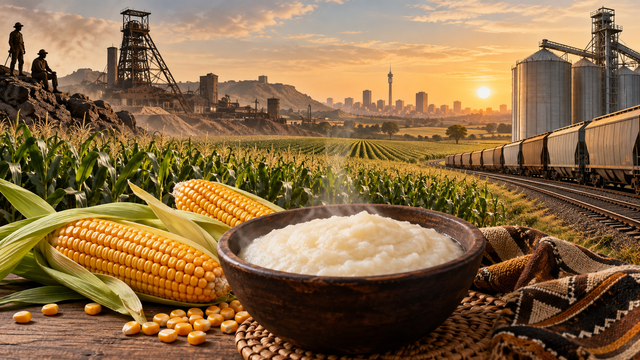
Somewhere in South Africa this morning, water will begin boiling in a pot and maize meal will be stirred into it.
For millions of households, there is nothing particularly remarkable about what happens next.
Pap feels old. Familiar. Almost inevitable.
But there is an odd historical fact hidden inside that pot:
The porridge is ancient. The maize is not.
Long before maize reached southern Africa, communities were already grinding sorghum and millet into meal and cooking thick grain porridges. Maize did not invent the idea of pap. It eventually replaced much of the grain inside it.
That distinction matters because it changes the question. The interesting story is not simply how maize arrived. It is how a crop domesticated thousands of kilometres away became so economically important that it eventually began to feel indigenous.
Before there was maize
Maize was first domesticated in Mesoamerica thousands of years ago and reached Africa after contact between the Old and New Worlds. Exactly how it spread across the continent is less tidy than the popular version. Archaeologists and historians have long debated the timing and routes of introduction into southern Africa. What can safely be said is that maize entered existing African trading and farming systems rather than arriving into an empty agricultural landscape.1
Southern African farmers were already cultivating drought-adapted grains such as sorghum and millet. These crops were eaten as porridges, fermented foods and beer. Maize entered that established food culture and, over time, proved attractive in suitable summer-rainfall areas because it could deliver large quantities of calories, store well and move relatively easily through growing markets.
Then somebody discovered gold
The real acceleration came in the second half of the nineteenth century.
Diamonds were discovered near Kimberley in the 1860s. Gold followed on the Witwatersrand in 1886. Within decades, South Africa had something it had never possessed at that scale before: large concentrations of people earning wages but no longer producing their own food.
Think about what that does to agriculture.
A mine produces gold. But a mining town produces demand.
Thousands of workers had to eat every day. Food needed to be affordable, transportable, storable and calorie dense. Maize fitted that system remarkably well. Historical research on 120 years of South African agriculture notes that maize was still mainly cultivated for local subsistence in the late nineteenth century, but the market changed with the mineral discoveries: both Black and white farmers supplied the rapidly expanding mining population.1
Maize was becoming more than food. It was becoming a wage-good — part of the economic machinery required to sustain an industrial labour force.
But the commercial system that followed was not built on a level playing field. Land dispossession, state support, agricultural credit, infrastructure and controlled marketing progressively strengthened white commercial agriculture while constraining Black farmers. The twentieth-century maize economy was therefore both a productivity story and a political-economy story.
State support also distorted where maize was grown. A recent spatial study covering South African agriculture from 1918 to 2015 estimates that, at its peak, policy-aligned shifts in maize location reduced output by roughly 7.9% to 15.3% and pushed production into areas with riskier rainfall. After the removal of these distortions, planted area continued to fall and production reconcentrated in less climate-risky locations.2
South Africa did not merely grow a maize industry.
It engineered one.
From 328,000 tonnes to a record crop
Production data
| Year | Million tonnes |
|---|---|
| 1904 | 0.328 |
| 1924 | 1.12 |
| 1937 | 2.15 |
| 1950 | 2.6 |
| 1970 | 6.13 |
| 1981 | 14.65 |
| 1992 | 3.05 |
| 1997 | 9.1 |
| 2010 | 12.815 |
| 2017 | 16.82 |
| 2021 | 16.315 |
| 2026 | 17.40184 |
More maize. Less land.
The record harvest is impressive. The productivity underneath it is more interesting.
In 1970, commercial farmers planted roughly 4.42 million hectares of maize and harvested about 6.13 million tonnes.
The latest 2026 estimate puts commercial maize area at 2.724 million hectares and expected production at 17.402 million tonnes — an average yield of 6.39 tonnes per hectare.3
Put differently: South Africa is producing almost three times as much maize from roughly 40% less land.
That is the agricultural development story hiding inside the bowl of pap.
Hybrid seed, fertiliser, mechanisation, improved agronomy, better genetics and later biotechnology all contributed. Deregulation mattered too: as support structures changed, some lower-productivity acreage exited maize and production became increasingly concentrated in areas capable of producing the crop efficiently. Grain SA describes the modern shift as one built on seed genetics, precision agriculture and improved production practices.4
More maize from less land
Productivity data
| Year | Area (m ha) | Output (m t) | Yield (t/ha) |
|---|---|---|---|
| 1970 | 4.42 | 6.13 | 1.39 |
| 1980 | 4.522 | 10.73 | 2.37 |
| 1990 | 3.251 | 8.34 | 2.57 |
| 2000 | 3.221 | 11.43 | 3.55 |
| 2010 | 2.744 | 12.815 | 4.67 |
| 2020 | 2.61 | 15.3 | 5.86 |
| 2026 | 2.7242 | 17.40184 | 6.39 |
A hectare is not just a piece of land. It is also a bundle of genetics, machinery, rainfall, fertiliser, knowledge, capital and risk management.
South Africa did not solve the maize equation primarily by finding more hectares.
It changed what each hectare could do.
One crop. Two economies.
Walk through a supermarket and maize appears to occupy one obvious aisle: maize meal.
That seriously understates its reach.
South Africa effectively operates two interconnected maize balance sheets. The latest 2026 forecast contains approximately 9.49 million tonnes of white maize and 7.91 million tonnes of yellow maize.3
The maize you see — and the maize you don’t
White maize travels through the food system relatively visibly. Yellow maize can take a more circuitous path.
A drought pushes up grain prices. Higher grain prices raise feed costs. Feed-cost pressure squeezes poultry, egg, pork or dairy margins. Some of that pressure can eventually appear in a product sitting several aisles away from the maize meal.
Grain SA has historically estimated South African maize demand at roughly equal orders of magnitude for human consumption and animal feed, while BFAP has long highlighted yellow maize as a primary energy source in feed rations.5
The supermarket makes these products look unrelated.
Agricultural economics reveals the connection.
And then there is the weather
This highly productive system also contains concentration risk.
The Free State, Mpumalanga and North West are expected to produce roughly 82% of South Africa’s 2026 commercial maize crop.3
That concentration creates scale and efficiency. It also means weather over a relatively concentrated portion of the country can matter to households everywhere from Johannesburg to Cape Town — and, during regional deficits, well beyond South Africa’s borders.
Commodity markets are unusually effective transmission mechanisms.
Rain falls — or fails to fall — on a farm. Months later, part of the economic consequence can surface on a supermarket receipt.
The final pass-through is neither immediate nor perfectly proportional. But the linkage is real enough that maize availability influences the price of maize meal and animal feed, particularly when domestic markets move from comfortable surplus toward tighter import-parity conditions.6
The 17.4-million-tonne machine
For now, the picture is unusually comfortable.
On 26 August 2026, the Crop Estimates Committee raised its forecast for South Africa’s commercial maize harvest to 17.402 million tonnes. The CEC describes it as the largest maize crop on record, 4.05% above the 2025 crop. Add an estimated 695,025 tonnes of non-commercial production and total maize output approaches 18.10 million tonnes.3
South Africa therefore enters the season with more than a domestic staple. It has a regional buffer and an export commodity. During neighbouring crop shortfalls, white-maize exports routinely move into Southern African markets; in stronger seasons yellow maize also participates in deeper international trade.7
But perhaps the extraordinary number is not 17.4 million tonnes.
It is 2.7 million hectares.
Because hidden inside those two numbers is more than a century of technological change, political intervention, exclusion, market reform, logistics investment and extraordinary productivity growth.
And it began with a crop that was not originally African.
Pap may feel timeless.
Its grain isn’t.
What is timeless is something more interesting: the ability of societies to take crops, technologies and markets from somewhere else and make them their own.
South Africa did not simply adopt maize. Over time, it built an economy around it.
Sources & notes
- South African Journal of Science. “Historical perspective on 120 years of agriculture.” The review notes the historical debate around maize introduction, the role of the diamond and gold discoveries in expanding the maize market, and production growth from 328,000 tonnes in 1904 to 1.68 million tonnes in 1935. Source.
- Greyling et al., American Journal of Agricultural Economics. “Agricultural policy and crop location: Long-run output and spatial climate risk consequences.” Estimates peak policy-aligned spatial distortions reduced maize output by 7.9%–15.3%. Source.
- South African Crop Estimates Committee, 26 August 2026. Seventh summer-crop production forecast: 17,401,840 tonnes commercial maize; 2,724,200 ha; 6.39 t/ha average yield; 9,487,790 tonnes white maize; 7,914,050 tonnes yellow maize; top three provinces 82% of crop. Department of Agriculture; CEC data mirror.
- Grain SA. “Genetic and mechanised innovations in SA maize production.” Discusses the contribution of seed genetics, mechanisation, biotechnology and precision agriculture to modern yields. Source.
- Grain SA / BFAP. Grain SA has reported local maize demand around 11.2 million tonnes in a representative season, roughly split between human food and animal feed; BFAP describes white maize as predominantly food and yellow maize as primarily an energy source in animal feed. Grain SA.
- National Agricultural Marketing Council / Grain SA. Analysis of the maize-meal value chain notes the importance and volatility of white-maize prices and their relationship with food security and downstream maize-meal pricing. Source.
- Grain SA. Supply-and-demand material documents white-maize exports into Southern African markets and the importance of animal and industrial use in yellow maize. Source.