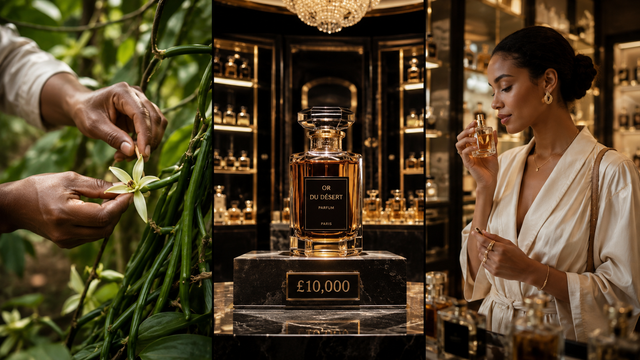
Perfume is usually sold as fantasy. Advertising campaigns speak of seduction, memory, elegance, identity and desire. A bottle of fine fragrance may be presented as something almost weightless: a mood, a signature, a trace left behind in a room.
Yet beneath this world of glamour lies a very physical reality. Perfume is rooted in soil, climate, labour, chemistry and trade.
Every bottle is an assembled product of agriculture and industry. Vanilla orchids, rose petals, jasmine buds, citrus peels, patchouli leaves, sandalwood, vetiver roots and synthetic aroma molecules are transformed into concentrated scent through farming, harvesting, extraction, formulation, packaging and retail. The fragrance industry therefore sits at the intersection of two very different worlds: fragile agricultural production in rural regions and high-margin luxury branding in global consumer markets.
This article examines the agro-industrial value chain behind perfumery. It begins with the story of Edmond Albius and vanilla, then follows the movement of botanical raw materials through Madagascar, Turkey, Bulgaria, India, Egypt, Italy and beyond. It also explores the unequal distribution of value between farmers, fragrance houses, luxury brands and retailers, before turning to global market trends and South Africa's growing fragrance economy.
Edmond Albius and the agricultural revolution of vanilla
Few ingredients reveal the agricultural foundation of perfumery as clearly as vanilla. Today, vanilla is associated with warmth, sweetness, comfort and sensuality. It is central to gourmand perfumes, oriental compositions, body-care products, candles and flavouring. But the global commercialisation of vanilla was made possible by one of the most important yet under-recognised breakthroughs in agricultural history.
Vanilla planifolia is an orchid native to the tropical forests of Mexico and Central America. For centuries, its natural reproduction was limited by its highly specialised floral anatomy and ecological conditions. When European colonial powers transported vanilla vines to tropical territories such as Mauritius and Reunion, then known as Bourbon Island, the plants grew but did not produce beans. The vines were alive, but commercially sterile.
The problem was pollination. Vanilla flowers contain a small membrane called the rostellum, which separates the male anther from the female stigma. Without the right natural pollinator or manual intervention, fertilisation does not occur. In 1837, Belgian botanist Charles Morren developed a manual pollination method, but it was too slow and impractical for large-scale farming.
The decisive breakthrough came in 1841 on the Bellevue plantation in Sainte-Suzanne, Reunion. Edmond Albius, a twelve-year-old enslaved boy, invented a rapid and efficient hand-pollination technique. Using a thin bamboo stick, needle or blade of grass, he lifted the rostellum and pressed the pollen-bearing anther against the stigma with his thumb. The method could be performed in seconds and achieved extremely high fertilisation rates.
This innovation changed the global geography of vanilla. It freed vanilla cultivation from its original ecological niche and allowed it to become a scalable plantation crop across the tropical belt. Reunion's vanilla output expanded rapidly in the decades that followed, and the method later spread to Madagascar, which would become the dominant global supplier of natural vanilla.
Yet the story of Albius is not only a story of botanical ingenuity. It is also a story of colonial extraction. The technique he invented generated wealth for French colonial planters and helped build a global commodity chain, but Albius himself never received meaningful financial reward. After the abolition of slavery in 1848, he took the surname Albius and later worked as a kitchen servant. He died in poverty in 1880.
His legacy remains embedded in the modern fragrance and flavour industries. Vanilla is still hand-pollinated using essentially the same method. Every natural vanilla bean used in a luxury perfume or gourmet product carries the trace of this agricultural labour system: delicate, skilled, repetitive and often poorly rewarded.
Madagascar and the fragility of vanilla dominance
Madagascar is now the centre of the global natural vanilla economy, producing the majority of the world's vanilla beans. The heart of this industry lies in the SAVA region, named after Sambava, Antalaha, Vohemar and Andapa. This northeastern part of the island provides the tropical conditions needed for Vanilla planifolia: warm temperatures, high humidity, generous rainfall and fertile soils.
But Madagascar's dominance is also a source of vulnerability. Vanilla is one of the most labour-intensive crops in the world. Each flower opens for only a short period, usually for a single day. Farmers and workers must pollinate the flowers by hand within a narrow time window. After harvesting, the green beans do not yet possess the familiar vanilla aroma. They must undergo a long curing process involving blanching, sweating, drying and conditioning. This process can take several months and requires skill, timing and careful handling.
The economics of vanilla are notoriously unstable. Prices have moved through extreme boom-and-bust cycles, shaped by cyclones, speculative buying, weak governance, global demand shifts and the availability of synthetic vanillin. At moments of shortage, vanilla prices can rise to extraordinary levels. During oversupply or market correction, prices can collapse, leaving farmers exposed.
This instability creates a painful contradiction. Vanilla is one of the world's most valuable agricultural ingredients, yet many of the farmers who produce it remain poor. They carry the risks of crop disease, theft, price crashes, climate shocks and cyclone damage, but they capture only a fraction of the final value created downstream.
Climate change intensifies the problem. Madagascar's vanilla regions are vulnerable to increasingly severe tropical cyclones, changing rainfall patterns, heat stress and soil degradation. Farmers also face practical constraints such as limited access to finance, storage, crop insurance and bargaining power. When prices fall, they cannot easily hold inventory or wait for better market conditions. When cyclones destroy vines, recovery can take years.
Government intervention has attempted to stabilise the market through export price floors, licensing systems and taxes. However, such interventions can create unintended consequences. Large multinational buyers and exporters often have the administrative capacity to navigate complex regulation, while smaller Malagasy exporters may be pushed into informal or parallel markets. In this way, policies intended to protect local value can sometimes reinforce the power of larger intermediaries.
The future of natural vanilla will therefore depend not only on demand from perfume and food companies, but also on whether Madagascar can build a more resilient agricultural system. Agroforestry, soil restoration, reforestation, farmer financing, traceability and fairer contracts will be essential if the industry is to survive climate pressure and social instability.
The botanical palette of perfumery
Vanilla is only one part of the perfume industry's agricultural base. Fine fragrance relies on a wide range of botanical raw materials, each shaped by terroir, climate, farming methods and extraction techniques.
Rose is one of the most iconic examples. Turkish rose, especially from Isparta Province, is widely used in perfumery. The petals are harvested by hand at dawn, when their aromatic compounds are most concentrated, and then processed through steam distillation or solvent extraction. Turkey accounts for a large share of global rose oil production, supported by small farms and cooperative processing systems.
Bulgarian rose, particularly from the Kazanlak Valley, carries a different identity. The region's Rose Valley is famous for Rosa damascena, which is valued for its soft, sweet, green and honeyed scent profile. Its protected geographical status adds another layer of value by linking the ingredient to place, tradition and authenticity.
Jasmine is another crucial floral input. Jasmine grandiflorum and jasmine sambac are highly prized in perfumery because of their sensual, narcotic and luminous profiles. The flowers are extremely delicate and must be picked by hand, often before sunrise. India and Egypt are major sourcing regions, but the market is competitive and sensitive to price shifts, crop conditions and labour availability.
Patchouli, grown in countries such as Indonesia, Malaysia, China and Rwanda, offers a different kind of olfactory foundation. Its leaves are harvested, dried and distilled to produce an earthy, woody, camphoraceous oil used in chypres, orientals, woody fragrances and incense-like compositions. In modern perfumery, cleaner and more refined patchouli fractions are used to give depth and longevity.
Bergamot from Calabria in southern Italy is essential to many fresh and citrus-based perfumes. Its oil is cold-pressed from the fruit peel and is valued for its bright, sparkling, slightly bitter and floral character. Because of the specific microclimate of Calabria, natural bergamot oil carries a chemical complexity that synthetic substitutes struggle to reproduce fully.
These examples show why natural raw materials still matter, even in an industry that makes extensive use of synthetic molecules. Synthetic ingredients can offer consistency, lower cost, safety and scalability. But natural extracts often provide complexity, texture and narrative value. In luxury fragrance, the story of origin, from Turkish rose to Madagascan vanilla, Calabrian bergamot and Indian jasmine, becomes part of the product's emotional and commercial appeal.
From farm to formula: where value is captured
The perfume value chain is highly unequal. At the beginning are farmers, harvesters and local processors. They perform the most physically demanding and climate-exposed work. They pollinate vanilla flowers, pick jasmine before sunrise, harvest rose petals by hand and distil leaves, roots, flowers and peels into essential oils, absolutes or concretes.
Further along the chain are multinational fragrance houses. Companies such as Givaudan, IFF, Symrise and dsm-firmenich dominate the global flavour and fragrance industry. They purchase natural and synthetic raw materials, develop fragrance compounds and supply formulas to beauty, personal-care, food, home-care and luxury companies. Their power lies in technical knowledge, research and development, regulatory expertise, proprietary formulas and deep relationships with global brands.
At the end of the chain are consumer brands and retailers. Luxury groups and beauty companies transform fragrance compounds into branded products. They invest in bottle design, packaging, celebrity campaigns, retail placement, sampling, influencer marketing and storytelling. Department stores, specialty beauty retailers and online platforms then add further markups.
This structure means that the agricultural ingredient itself often represents only a small share of the final retail price of a perfume bottle. The consumer may pay for rare vanilla, precious rose or hand-picked jasmine, but much of the price reflects branding, packaging, marketing, distribution and retail margins.
For example, in a luxury perfume bottle selling for $150, the fragrance liquid itself may account for only a small percentage of the final price. Packaging, advertising, retailer margins and brand profit often make up the majority. This does not mean the raw materials are unimportant. On the contrary, they are essential to the product's identity. But economically, the people and ecosystems that produce them often capture relatively little of the value they help create.
This imbalance is one of the central ethical questions facing the fragrance industry. If luxury brands build stories around natural origin, craftsmanship and authenticity, then how much responsibility do they carry toward the farming communities that make those stories possible?
Sustainability, traceability and the new politics of scent
As consumers become more conscious of sustainability, the fragrance industry is under pressure to make its supply chains more transparent. Historically, perfume supply chains have been opaque. A finished fragrance may contain dozens or even hundreds of ingredients sourced from multiple countries, transformed by different processors and blended into proprietary formulas. This complexity makes it difficult for consumers to know who produced the raw materials, under what conditions, and with what environmental impact.
Sustainable supply-chain management is therefore becoming a strategic priority. Brands and fragrance houses are investing in traceability systems, long-term sourcing partnerships, fair-trade certification, regenerative agriculture, biodiversity protection and community development programmes.
Blockchain and digital traceability platforms are also being explored as tools to verify origin, track transactions and reduce fraud or adulteration. In theory, such systems can help ensure that farmers receive fairer prices and that brands can prove the authenticity of their sourcing claims. In practice, traceability only matters if it is linked to real economic benefits for producers. A transparent supply chain that still leaves farmers poor is not a fair supply chain.
Sustainability also involves a careful balance between natural and synthetic ingredients. Natural does not automatically mean sustainable. Some botanicals require large amounts of land, water and labour. Others may place pressure on endangered species or fragile ecosystems. Synthetic molecules can reduce pressure on certain natural resources, but they also raise questions about petrochemical inputs, biodegradability and consumer perception.
The future of perfumery will not be purely natural or purely synthetic. It will likely be hybrid: combining responsibly sourced botanicals, biotechnology, green chemistry, precision fermentation, synthetic aroma molecules and circular packaging systems.
Global market trends in 2026
The global fragrance market has grown strongly in the post-pandemic period. Several forces are reshaping demand.
Fragrance as self-expression
Consumers are no longer buying perfume only for formal occasions. Many now treat scent as part of daily identity, mood management and personal ritual. This shift supports demand for both premium and accessible fragrances.
Niche and artisanal growth
Consumers want scents that feel distinctive rather than mass-market. Independent houses often emphasise unusual ingredients, higher concentrations, artistic storytelling and limited distribution. This has expanded the market beyond traditional designer fragrance.
Genderless positioning
Unisex and genderless fragrances are becoming mainstream. Younger consumers are less attached to the old division between for men and for women. Instead, they are drawn to mood, ingredient, aesthetic and identity. Woods, musks, ambers, citrus, tea, fig, incense and gourmand notes can now be positioned beyond binary gender categories.
Digital discovery
E-commerce is changing how fragrances are discovered and sold. Perfume has always been difficult to sell online because scent cannot be directly experienced through a screen. Brands are responding with discovery sets, sample subscriptions, AI-guided scent quizzes, digital consultations and influencer-led storytelling. Social media has also turned fragrance into a content category, with reviewers and collectors shaping demand.
Sustainability as signal
Refillable bottles, natural ingredients, vegan claims, cruelty-free positioning, ethical sourcing and recyclable packaging are increasingly part of brand strategy. However, this creates a risk of greenwashing. Consumers may demand not only claims, but proof.
The winners in this new market will be brands that can combine creativity, credibility and supply-chain integrity. A perfume can no longer rely only on a beautiful bottle and an expensive campaign. Increasingly, consumers want to know where the scent comes from, what it represents, and whether its production aligns with their values.
South Africa's fragrance market: luxury, accessibility and emotional scent culture
South Africa offers a compelling example of how global fragrance trends are expressed in a local market. The country's fragrance and cosmetics sector reflects sharp differences in income, retail access, aspiration and cultural use of scent.
At the upper end of the market, niche and luxury fragrance retail is expanding through stores such as Skins Cosmetics and ARC. These retailers introduce South African consumers to international perfume houses, including ultra-premium and niche brands. For affluent consumers, fragrance is increasingly a marker of individuality, taste and global cultural participation.
The premium designer segment is also strong. Brands available through Woolworths, ARC and major beauty retailers appeal to middle- and high-income consumers who want recognisable international names. These consumers may use fragrance as an affordable entry point into luxury. Buying a designer perfume is far more accessible than buying couture fashion, but it still carries the symbolic value of the brand.
At the mass and accessible end of the market, direct-selling models such as Avon and Justine remain important. These businesses reach consumers through personal networks and community-based sales structures. They also offer lower-cost fragrances and personal-care products to consumers who may not regularly shop in premium retail environments.
South Africa also has a strong culture of oil-based perfumes and attars. These products are valued for longevity, intensity and affordability. They often circulate through informal markets, small fragrance shops, mall kiosks and independent sellers. This creates a fragrance economy that is not fully captured by formal luxury retail data.
Another important local dynamic is the emotional role of scent. For many consumers, fragrance is not only about status. It is also about confidence, memory, cleanliness, attraction, spirituality, comfort and mood. Citrus scents may be associated with freshness and energy. Gourmand notes such as vanilla, caramel and chocolate may evoke warmth and nostalgia. Florals may signal softness, femininity or calm. Oud, amber and musk may communicate richness, depth and longevity.
Digital commerce is further changing the South African market. Social media, TikTok reviews, Instagram boutiques and online fragrance communities allow consumers to discover niche brands, alternatives, oils, decants and international trends. This lowers barriers to entry for smaller sellers and creates space for local fragrance entrepreneurship.
South Africa's trade position is also important. The country imports much of its fine fragrance, especially from Europe, while also acting as a regional distribution hub into neighbouring African countries. This means South Africa could play a larger role in African fragrance retail, distribution, private-label development and eventually local scent manufacturing.
Strategic outlook: the future of perfume is agricultural and ethical
The perfume industry stands at a strategic crossroads. On one hand, demand for fragrance is growing. Consumers are buying more scents, exploring niche brands, embracing unisex perfumes and treating fragrance as part of daily self-expression. On the other hand, the agricultural foundations of perfumery are under pressure from climate change, biodiversity loss, labour inequality and supply-chain opacity.
The industry cannot continue to romanticise natural ingredients while ignoring the conditions under which they are produced. Vanilla from Madagascar, rose from Turkey and Bulgaria, jasmine from India and Egypt, bergamot from Calabria and patchouli from Indonesia all depend on farmers, harvesters and ecosystems. Without resilient agricultural communities, luxury perfumery loses both its raw materials and its authenticity.
For fragrance houses and luxury brands, the strategic priority will be securing long-term access to high-quality natural ingredients. This will require more than transactional sourcing. It will require investment in farmer resilience, climate adaptation, fair pricing, biodiversity protection and transparent procurement.
For producing countries, the opportunity lies in moving up the value chain. Rather than exporting only raw or semi-processed materials, they can develop local extraction, formulation, branding, certification and distribution capabilities. This is especially relevant for African economies with botanical resources, young consumer markets and growing digital retail infrastructure.
For South Africa, the fragrance sector presents an opportunity that goes beyond importing luxury products. The country could become a regional hub for African fragrance retail, oil-based perfume innovation, botanical sourcing, local brand development and culturally resonant scent storytelling.
Ultimately, perfume should be understood not as a purely luxury product, but as an agro-industrial product shaped by history, ecology and power. Its beauty is real, but so is the labour behind it. Its emotional power is real, but so are the farms, flowers, forests, laboratories and trade routes that make it possible.