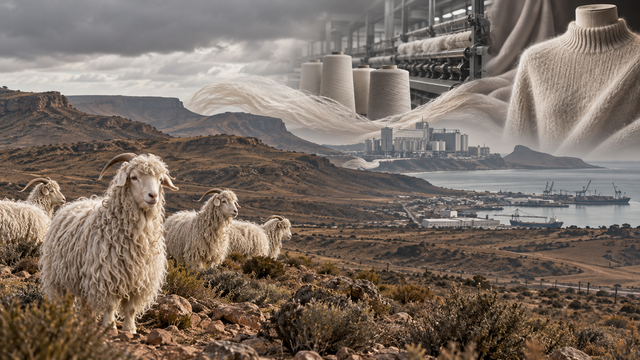
The Brief
- Global greasy mohair production is estimated at roughly 4,748 tonnes.
- South Africa produces about 2,500 tonnes and remains the world leader.
- Southern Africa dominates supply, especially once Lesotho is included.
- Local processing strength is concentrated in scouring and combing, not final garments.
- That makes mohair one of the clearest examples of South Africa’s value-capture debate.
Estimated South African share of global mohair output, making the country the clear anchor of the world market.
Share of global mohair that is scoured and combed in South Africa before being exported as semi-processed tops.
Approximate portion of local tops that is spun into yarn domestically. Finished garments account for even less.
Illustrative luxury retail price of a mohair sweater whose raw fibre value may begin at only about $15 at farmgate.
The three questions underneath this story
- Why does South Africa control so much of the world’s mohair, yet still remain mostly a price taker?
- Where does the money really accumulate between the goat in the Karoo and the sweater in a luxury store?
- What kind of local value addition is realistic if South Africa wants more of that value to stay at home?
Mohair is one of those industries that can look tiny on paper and huge once you follow the money. In global fibre terms, it is almost invisible. Annual production is measured in thousands of tonnes, not millions. But once the fibre is cleaned, spun, blended, knitted, branded and hung in a luxury store, that tiny agricultural output suddenly occupies very expensive commercial territory.
That is what makes the South African mohair story so interesting. The country is not a fringe player in a niche market. It is the market’s centre of gravity. South Africa produces roughly half of the world’s raw mohair clip and, together with Lesotho, Southern Africa controls most of global supply. It also does something many commodity exporters do not do: it carries the fibre well beyond the farm. Scouring and combing happen largely in South Africa, concentrated around Gqeberha and Kariega.
Yet the story does not end in industrial dominance. It bends into a familiar South African problem. The country participates deeply in the early stages of the value chain, then loses momentum as the value becomes more design-intensive, brand-intensive and retail-intensive. Mohair may start in the Karoo, but the richest commercial layer often emerges later in Milan, Biella, Paris, London or New York.
Who produces the world’s mohair?
Chart data
| Category | Share (%) |
|---|---|
| South Africa | 52.6 |
| Lesotho | 15.4 |
| Turkey | 8.4 |
| Australia | 3.8 |
| United States | 3.2 |
| Argentina & rest | 16.6 |
South Africa and Lesotho together account for more than two-thirds of global output, reinforcing the region’s strategic importance in a very small but high-value natural fibre market.
How rare is mohair?
Chart data
| Category | Annual production (tonnes) |
|---|---|
| Synthetics | 91000000 |
| Cotton | 24500000 |
| Wool | 1000000 |
| Cashmere | 18000 |
| Alpaca | 6200 |
| Mohair | 4748 |
Mohair is not a mass-market fibre. It sits at the extreme low-volume end of the global fibre spectrum, which helps explain its premium positioning.
A luxury fibre hiding inside a tiny market
Mohair’s scarcity matters because it explains why the fibre can command such status without ever becoming a volume story. Polyester dominates the textile world. Cotton remains a giant. Even sheep wool looks large next to mohair. By contrast, mohair is an ultra-speciality fibre that survives commercially not because it is everywhere, but because it is difficult to replicate well at the highest end.
It is light, lustrous, strong and warm without being heavy. It dyes well. It blends well. It photographs beautifully. These are not trivial details. They are precisely the qualities that allow a fibre from a semi-arid corner of South Africa to travel into high-end knitwear, tailoring blends, interiors and designer collections.
That scarcity also means supply cannot be expanded overnight. Angora goats are not generic livestock. They need the right environment and careful management. The Karoo’s semi-arid conditions, shrubland vegetation and low humidity suit them unusually well. This helps explain why South Africa became dominant and why that dominance has proven resilient over time.
Why the Karoo works
Angora goats are browsers, not simply grazers. They thrive in dry-land environments with shrub-rich vegetation, low humidity and room to move. The Eastern Cape remains the heartland of the industry, with important production districts stretching through Graaff-Reinet, Jansenville, Willowmore, Steytlerville, Aberdeen, Cradock and Somerset East, while the Karoo zones of the Western and Northern Cape provide additional support.
In other words, South Africa’s mohair position is not an accident of fashion. It is rooted in geography, agricultural know-how and a processing ecosystem built over decades.
The country that dominates the clip does not dominate the final price
Here is the part that makes the industry economically revealing. South Africa does not merely grow mohair. It processes most of the world’s clip into scoured fibre and combed tops. That already puts the industry ahead of many other primary sectors where raw output is shipped abroad with limited transformation.
But the next steps are where the funnel tightens. Only a small share of locally combed tops is spun domestically. An even smaller share becomes finished textiles or garments inside South Africa. So while the country is critical to the early industrial stages, it captures much less of the design, brand, retail and consumer margin at the end.
The value-capture problem
Mohair demonstrates a South African paradox: strong control over production and primary processing does not automatically translate into strong control over value.
From Karoo goat to luxury retail price
Chart data
| Category | Cumulative value per 300g garment (USD) |
|---|---|
| Farmgate fibre | 15 |
| Scouring & combing | 35 |
| Spinning & dyeing | 70 |
| Knitting & assembly | 170 |
| Wholesale/logistics | 350 |
| Retail/marketing/VAT | 1000 |
The $1,000 sweater is not pure profit for luxury brands. It reflects fibre loss, scouring, spinning, blending, transport, design, wholesale structure, marketing, retail overhead and tax. But it also shows clearly where the value pool becomes much larger.
This is where mohair becomes more than an agricultural curiosity. It becomes a practical lesson in value-chain economics. At farmgate, the fibre inside a 300-gram luxury sweater might represent roughly $15. After scouring and combing, the value rises. After spinning and dyeing, it rises again. But once brand positioning, wholesale mark-ups, prime retail rent, fashion marketing and luxury pricing architecture enter the picture, the economics change scale completely.
That does not mean South Africa should assume every downstream rand is there for the taking. It is not. The final retail price absorbs many real costs. But it does mean the country currently exits the chain before the biggest commercial layers fully open up.
Why the gap exists
There are at least four reasons South Africa does not automatically convert mohair dominance into full value-chain dominance. The first is scale. Luxury garment manufacturing needs specialised equipment, design capability, skilled labour, marketing networks and reliable order flow. The domestic market for premium mohair apparel is simply not large enough on its own to support industrial scale.
The second is cost. South Africa can scour and comb competitively because those stages align well with its existing industry base. But spinning, fine-gauge knitting and high-end finishing demand consistent energy, specialised expertise and very reliable logistics. Those are not impossible constraints, but they are real ones.
The third is market structure. Price discovery still happens in a system shaped heavily by global buyers. Producers are numerous; buyers are concentrated. That oligopsony structure leaves farmers and even local brokers exposed to international fashion demand, exchange-rate shifts and offshore purchasing power.
The fourth is history. South Africa built strong competence around growing, classing, auctioning, scouring and combing. That industrial muscle matters. But it also means the industry evolved around export efficiency at the semi-processed stage rather than around building large local knitwear brands.
How auction prices moved
Chart data
| Category | Superfine Kid (R/kg) | Fine Kid (R/kg) | Young Goat (R/kg) | Fine Adult (R/kg) |
|---|---|---|---|---|
| 2015 | 310 | 260 | 170 | 130 |
| 2018 | 1256.1 | 820 | 480 | 290 |
| 2019 | 613 | 420 | 289.66 | 218.97 |
| 2021 | 540 | 380 | 240 | 175 |
| 2024 | 780 | 580 | 340 | 220 |
Mohair prices can be rewarding, but they are not smooth. The 2018 price spike and subsequent correction showed how sensitive the sector is to demand cycles and reputation shocks.
Current structure of domestic processing
Chart data
| Category | Domestic processing share (%) |
|---|---|
| Raw fleece | 100 |
| Scouring & combing | 82 |
| Spinning | 8 |
| Weaving / knitting | 4 |
| Finished garments | 2 |
South Africa already does the hard early work. The sharp drop comes after combed tops, where export dependence rises again.
What value addition should actually mean here
This is the point where policy conversations often become too broad. “We should beneficiate more” is easy to say and hard to operationalise. Mohair suggests a more disciplined answer. Not every stage of the value chain is equally realistic, and not every stage offers the same risk-adjusted payoff.
The most plausible next step is not to imagine South Africa suddenly becoming a global fashion capital. It is to ask whether the country can deepen its position in the stages just beyond combed tops: more spinning, more specialised yarn production, more industrial knitting, more textile finishing and more niche premium local brands with export capability.
That route matters because it uses an existing advantage rather than inventing one from scratch. The fibre is already here. The processing cluster is already here. The provenance story is already here. The sustainability story is increasingly here too, thanks to the Responsible Mohair Standard, which has become close to a basic requirement for access to top-end buyers.
Sustainability became an economic moat
After the 2018 animal-welfare controversy, the industry was forced to move quickly. Today, around 90% of South Africa’s clip is estimated to be RMS certified. That is not just an ethical badge. It is part of the industry’s market infrastructure. In high-end fashion supply chains, certification increasingly determines who gets access to serious buyers and who does not.
What if South Africa value-added more?
Chart data
| Category | Projected industrial value (R billion) | Projected direct employment (jobs) |
|---|---|---|
| Status quo | 1.8 | 30000 |
| Modest secondary | 2.7 | 34500 |
| High value capture | 4.2 | 42000 |
The scenario logic is simple: modest gains in spinning and finishing could create a meaningful lift in industrial value and employment without requiring South Africa to own every stage of global luxury retail.
Even the research’s “modest secondary” scenario is telling. It assumes more domestic spinning and a small increase in garment finishing. The revenue uplift is material. The employment effect is also material, especially for the Eastern Cape, where the mohair ecosystem is already rooted. That does not solve every industrial problem. But it suggests that targeted value addition can be more than slogan.
Why mohair says something bigger about South Africa
Mohair is easy to dismiss because it is small. That would be a mistake. Small sectors often reveal the structure of an economy more clearly than large ones because the moving parts are easier to see. In one compact industry, mohair shows South Africa’s strengths and its limits: world-class agricultural specialisation, real primary processing capability, weak downstream scale, concentrated buyer power and an ongoing debate about how much more industrial depth is feasible.
It also shows that value addition is not a moral statement. It is a commercial question. The useful question is not whether South Africa should make every sweater. It is where the country can move one or two steps further down the chain in a way that is economically defensible.
That answer may lie less in trying to replace Italian fashion houses and more in building stronger positions in spinning, niche premium textiles, contract manufacturing, provenance branding and selective local luxury production. In other words: keep the goat, keep the combing mill, and hold on to more of what comes next.
Three takeaways worth holding on to
| Question | Short answer | Why it matters |
|---|---|---|
| Why is South Africa so important in mohair? | Because the Karoo suits Angora goats unusually well, and the country built a strong auctioning and processing ecosystem around that advantage. | It means South Africa is not just a producer. It is a strategic node in the global trade. |
| Why is the country still a price taker? | Because the buyer side is concentrated and the highest-value stages often happen offshore in spinning, branding, design and retail. | Dominating supply does not automatically mean dominating margins. |
| Where should value addition begin? | With realistic expansion in spinning, yarns, textiles and selective finishing, rather than with an attempt to own every stage at once. | That is where the economic case looks strongest. |
The easy-reading conclusion
A luxury mohair sweater may end up on a rail in Europe or North America, but the story starts much earlier and much further south. It starts in a dry landscape where goats turn scrub into one of the world’s rarest textile fibres. South Africa already does more with that fibre than many commodity exporters do with their own raw materials. The country farms it, sorts it, auctions it and combs most of it.
But mohair also shows where the next argument begins. If South Africa wants to keep more value at home, the objective should not be vague beneficiation rhetoric. It should be strategic progression: more spinning, more specialised textile capacity, stronger provenance branding and more local firms capable of turning an agricultural advantage into industrial margin. Mohair will remain a niche. The opportunity is to make it a more valuable niche on South African soil.